All the King s Horses and All the King s Men Couldn t Put the Kingfish Back Together Again
| "Humpty Dumpty" | |
|---|---|
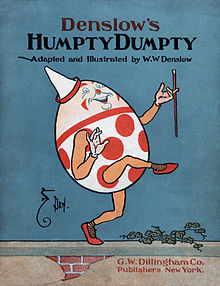 Analogy past Westward. W. Denslow, 1904 | |
| Nursery rhyme | |
| Published | 1797 |
Humpty Dumpty is a graphic symbol in an English language nursery rhyme, probably originally a riddle and one of the best known in the English-speaking world. He is typically portrayed every bit an anthropomorphic egg, though he is not explicitly described as such. The showtime recorded versions of the rhyme appointment from late eighteenth-century England and the melody from 1870 in James William Elliott's National Nursery Rhymes and Nursery Songs.[1] Its origins are obscure, and several theories have been advanced to suggest original meanings.
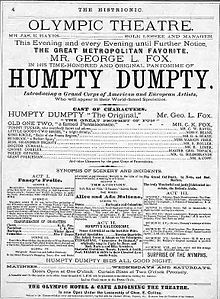
Humpty Dumpty was popularised in the United States on Broadway by role player George L. Fox in the pantomime musical Humpty Dumpty.[2] The show ran from 1868 to 1869, for a total of 483 performances, becoming the longest-running Broadway prove until it was surpassed in 1881 by Hazel Kirke.[iii] Every bit a grapheme and literary allusion, Humpty Dumpty has appeared or been referred to in many works of literature and popular culture, peculiarly English author Lewis Carroll'south 1871 book Through the Looking-Drinking glass, in which he was described as an egg. The rhyme is listed in the Roud Folk Song Index equally No. 13026.
Lyrics and tune [edit]
The rhyme is 1 of the best known in the English language language. The common text from 1954 is:[4]
Humpty Dumpty sabbatum on a wall,
Humpty Dumpty had a not bad fall.
All the male monarch's horses and all the king'due south men
Couldn't put Humpty together over again.
Information technology is a single quatrain with external rhymes[5] that follow the pattern of AABB and with a trochaic metre, which is common in plant nursery rhymes.[six] The melody commonly associated with the rhyme was first recorded by composer and plant nursery rhyme collector James William Elliott in his National Nursery Rhymes and Nursery Songs (London, 1870), as outlined below:[7]

Origins [edit]

Illustration from Walter Crane'south Female parent Goose'due south Nursery Rhymes (1877), showing Humpty Dumpty as a boy
The earliest known version was published in Samuel Arnold's Juvenile Amusements in 1797[one] with the lyrics:[4]
Humpty Dumpty sat on a wall,
Humpty Dumpty had a corking fall.
Four-score Men and Four-score more,
Could not make Humpty Dumpty where he was before.
William Carey Richards (1818–1892) quoted the poem in 1843, commenting, "when we were 5 years sometime ... the following parallel lines... were propounded equally a riddle ... Humpty-dumpty, reader, is the Dutch or something else for an egg".[8]
A manuscript addition to a copy of Female parent Goose'south Melody published in 1803 has the modern version with a different final line: "Could not prepare Humpty Dumpty upward again".[4] Information technology was published in 1810 in a version of Gammer Gurton'southward Garland.[9] (Note: Original spelling variations left intact.)
Humpty Dumpty sate on a wall,
Humpti Dumpti had a swell autumn;
Threescore men and threescore more,
Cannot place Humpty dumpty as he was before.
In 1842, James Orchard Halliwell published a collected version equally:[10]
Humpty Dumpty lay in a beck.
With all his sinews effectually his neck;
Forty Doctors and forty wrights
Couldn't put Humpty Dumpty to rights!
The modern-day version of this nursery rhyme, as known throughout the UK since at to the lowest degree the mid-twentieth century, is as follows:
Humpty Dumpty sat on a wall,
Humpty Dumpty had a great autumn;
All the King's horses
And all the King's men,
Couldn't put Humpty together again.
According to the Oxford English Lexicon, in the 17th century the term "humpty dumpty" referred to a drink of brandy boiled with ale.[4] The riddle probably exploited, for misdirection, the fact that "humpty dumpty" was besides eighteenth-century reduplicative slang for a short and impuissant person.[11] The riddle may depend upon the assumption that a clumsy person falling off a wall might not be irreparably damaged, whereas an egg would be. The rhyme is no longer posed every bit a riddle, since the answer is at present then well known. Similar riddles have been recorded by folklorists in other languages, such as "Boule Boule" in French, "Lille Trille" in Swedish and Norwegian, and "Runtzelken-Puntzelken" or "Humpelken-Pumpelken" in different parts of Frg—although none is as widely known as Humpty Dumpty is in English.[4] [12]
Significant [edit]

The rhyme does not explicitly state that the subject is an egg, perchance because it may have been originally posed as a riddle.[4] There are besides various theories of an original "Humpty Dumpty". One, avant-garde by Katherine Elwes Thomas in 1930[13] and adopted by Robert Ripley,[iv] posits that Humpty Dumpty is King Richard Iii of England, depicted every bit humpbacked in Tudor histories and particularly in Shakespeare's play, and who was defeated, despite his armies, at Bosworth Field in 1485.
In 1785, Francis Grose's Classical Lexicon of the Vulgar Natural language noted that a "Humpty Dumpty" was "a short clumsey [sic] person of either sex, also ale boiled with brandy"; no mention was made of the rhyme.[14]
Dial in 1842 suggested jocularly that the rhyme was a metaphor for the downfall of Cardinal Wolsey; just as Wolsey was not buried in his intended tomb, and so Humpty Dumpty was not buried in his shell.[15]
Professor David Daube suggested in The Oxford Mag of 16 Feb 1956 that Humpty Dumpty was a "tortoise" siege engine, an armoured frame, used unsuccessfully to approach the walls of the Parliamentary-held city of Gloucester in 1643 during the Siege of Gloucester in the English Civil State of war. This was on the ground of a gimmicky account of the attack, simply without testify that the rhyme was connected.[16] The theory was role of an bearding series of articles on the origin of plant nursery rhymes and was widely acclaimed in academia,[17] only it was derided by others as "ingenuity for ingenuity's sake" and declared to be a spoof.[xviii] [19] The link was nevertheless popularised by a children'south opera All the Male monarch's Men by Richard Rodney Bennett, first performed in 1969.[20] [21]
From 1996, the website of the Colchester tourist lath attributed the origin of the rhyme to a cannon recorded every bit used from the church of St Mary-at-the-Wall by the Royalist defenders in the siege of 1648.[22] In 1648, Colchester was a walled boondocks with a castle and several churches and was protected past the city wall. The story given was that a big cannon, which the website claimed was colloquially called Humpty Dumpty, was strategically placed on the wall. A shot from a Parliamentary cannon succeeded in dissentious the wall beneath Humpty Dumpty, which caused the cannon to tumble to the ground. The Royalists (or Cavaliers, "all the Male monarch's men") attempted to enhance Humpty Dumpty on to another role of the wall, only the cannon was and so heavy that "All the King'southward horses and all the King'southward men couldn't put Humpty together again". Writer Albert Jack claimed in his 2008 book Pop Goes the Weasel: The Cloak-and-dagger Meanings of Nursery Rhymes that there were ii other verses supporting this claim.[23] Elsewhere, he claimed to have found them in an "former dusty library, [in] an even older book",[24] but did not country what the book was or where it was found. It has been pointed out that the two additional verses are non in the style of the seventeenth century or of the existing rhyme, and that they do not fit with the earliest printed versions of the rhyme, which practise not mention horses and men.[22]
In popular civilisation [edit]
Humpty Dumpty has become a highly popular nursery rhyme graphic symbol. American actor George L. Flim-flam (1825–77) helped to popularise the character in nineteenth-century stage productions of pantomime versions, music, and rhyme.[25] The character is too a common literary allusion, particularly to refer to a person in an insecure position, something that would be hard to reconstruct once broken, or a short and fat person.[26]
Lewis Carroll'south Through the Looking-Drinking glass [edit]

Humpty Dumpty appears in Lewis Carroll'south Through the Looking-Glass (1871), a sequel to Alice in Wonderland from six years prior. Alice remarks that Humpty is "exactly similar an egg," which Humpty finds to exist "very provoking." Alice clarifies that she said he looks like an egg, not that he is one. They discuss semantics and pragmatics[27] when Humpty Dumpty says, "my name ways the shape I am," and later:[28]
"I don't know what you mean by 'glory,' " Alice said.
Humpty Dumpty smiled contemptuously. "Of course you don't—till I tell you. I meant 'there's a dainty knock-down argument for you!'"
"Simply 'glory' doesn't hateful 'a nice knock-down statement'," Alice objected.
"When I utilize a word," Humpty Dumpty said, in rather a scornful tone, "it means only what I choose it to mean—neither more than nor less."
"The question is," said Alice, "whether you can make words hateful so many dissimilar things."
"The question is," said Humpty Dumpty, "which is to exist master—that's all."
Alice was too much puzzled to say anything, so after a minute Humpty Dumpty began again. "They've a temper, some of them—particularly verbs, they're the proudest—adjectives you tin practice anything with, but non verbs—however, I can manage the whole lot! Impenetrability! That's what I say!"
This passage was used in Uk by Lord Atkin in his dissenting judgement in the seminal case Liversidge v. Anderson (1942), where he protested nearly the baloney of a statute by the majority of the House of Lords.[29] It also became a popular citation in The states legal opinions, appearing in 250 judicial decisions in the Westlaw database equally of 19 April 2008[update], including 2 Supreme Court cases (TVA five. Hill and Zschernig v. Miller).[30]
A. J. Larner suggested that Carroll's Humpty Dumpty had prosopagnosia on the basis of his description of his finding faces hard to recognise:[31]
"The confront is what 1 goes by, generally," Alice remarked in a thoughtful tone. "That'due south but what I mutter of," said Humpty Dumpty. "Your face is the same every bit everybody has—the ii eyes,—" (marking their places in the air with his thumb) "nose in the middle, mouth under. It's always the same. At present if you had the 2 eyes on the aforementioned side of the nose, for instance—or the rima oris at the top—that would be some help."
James Joyce'due south Finnegans Wake [edit]
James Joyce used the story of Humpty Dumpty as a recurring motif of the Fall of Homo in the 1939 novel Finnegans Wake.[32] [33] One of the virtually easily recognizable references is at the end of the second affiliate, in the first poesy of the Ballad of Persse O'Reilly:
Have you heard of 1 Humpty Dumpty
How he roughshod with a coil and a rumble
And curled up like Lord Olofa Crumple
By the butt of the Magazine Wall,
(Chorus) Of the Magazine Wall,
Hump, helmet and all?
In movie, literature and music [edit]
Robert Penn Warren's 1946 American novel All the King's Men is the story of populist politician Willie Stark'south rise to the position of governor and eventual autumn, based on the career of the infamous Louisiana Senator and Governor Huey Long. It won the 1947 Pulitzer Prize and was twice fabricated into a film in 1949 and 2006, the one-time winning the Academy Award for best pic.[34] This was echoed in Carl Bernstein and Bob Woodward'south book All the President's Men, about the Watergate scandal, referring to the failure of the President'southward staff to repair the damage in one case the scandal had leaked out. It was filmed as All the President'southward Men in 1976, starring Robert Redford and Dustin Hoffman.[35]
In 1983, an advert for Kinder Surprise featuring a realistic version of the Humpty Dumpty character (designed by Mike Quinn, who worked at the Jim Henson's Creature Shop) and directed by Mike Portelly, was banned shortly after release, due to being highly unsettling. The advertizing aired just on ITV and its franchises.
In 2021, American band AJR released a song titled "Humpty Dumpty" on their anthology OK Orchestra. The vocal uses the nursery rhyme as a parallel for hiding ane's true emotions every bit things, typically unpleasant, happen to the singer.
Jasper Fforde's 2005 British novel The Big Over Easy is an exercise in applesauce, in which Humpty Stuyvesant Van Dumpty III has been murdered and Detective Jack Spratt of the Nursery Crime Division is ready the task of solving the mystery.
In science [edit]
Humpty Dumpty has been used to demonstrate the second law of thermodynamics. The law describes a process known as entropy, a measure of the number of specific ways in which a system may exist arranged, often taken to be a measure of "disorder". The higher the entropy, the college the disorder. After his fall and subsequent shattering, the inability to put him together once more is representative of this principle, equally it would be highly unlikely (though non impossible) to return him to his earlier state of lower entropy, equally the entropy of an isolated system never decreases.[36] [37] [38]
Come across too [edit]
- List of nursery rhymes
References [edit]
- ^ a b Emily Upton (24 April 2013). "The Origin of Humpty Dumpty". What I Learned Today. Retrieved 19 September 2015.
- ^ Kenrick, John (2017). Musical Theatre: A History. ISBN9781474267021 . Retrieved 16 May 2020.
- ^ "Humpty Dumpty". IBDB.com. Internet Broadway Database.
- ^ a b c d e f 1000 Opie & Opie (1997), pp. 213–215.
- ^ J. Smith, Poetry Writing (Teacher Created Resources, 2002), ISBN 0-7439-3273-0, p. 95.
- ^ P. Chase, ed., International Companion Encyclopedia of Children's Literature (London: Routledge, 2004), ISBN 0-203-16812-7, p. 174.
- ^ J. J. Fuld, The Book of World-Famous Music: Classical, Popular, and Folk (Courier Dover Publications, 5th ed., 2000), ISBN 0-486-41475-2, p. 502.
- ^ Richards, William Carey (March–April 1844). "Monthly chat with readers and correspondents". The Orion. Penfield, Georgia. Ii (5 & half-dozen): 371.
- ^ Joseph Ritson, Gammer Gurton'south Garland: or, the Nursery Parnassus; a Selection Collection of Pretty Songs and Verses, for the Amusement of All Little Good Children Who Can Neither Read Nor Run (London: Harding and Wright, 1810), p. 36.
- ^ J. O. Halliwell-Phillipps, The Nursery Rhymes of England (John Russell Smith, 6th ed., 1870), p. 122.
- ^ E. Partridge and P. Beale, Lexicon of Slang and Unconventional English language (Routledge, eighth ed., 2002), ISBN 0-415-29189-v, p. 582.
- ^ Lina Eckenstein (1906). Comparative Studies in Plant nursery Rhymes. pp. 106–107. OL 7164972M. Retrieved thirty January 2018 – via annal.org.
- ^ E. Commins, Lessons from Female parent Goose (Lack Worth, Fl: Humanics, 1988), ISBN 0-89334-110-X, p. 23.
- ^ Grose, Francis (1785). A Classical Lexicon of the Vulgar Tongue. S. Hooper. pp. 90–.
- ^ "Juvenile Biography No IV: Humpty Dumpty". Dial. 3: 202. July–December 1842.
- ^ "Plant nursery Rhymes and History", The Oxford Magazine, vol. 74 (1956), pp. 230–232, 272–274 and 310–312; reprinted in: Calum M. Carmichael, ed., Collected Works of David Daube, vol. 4, "Ethics and Other Writings" (Berkeley, CA: Robbins Collection, 2009), ISBN 978-1-882239-15-3, pp. 365–366.
- ^ Alan Rodger. "Obituary: Professor David Daube". The Independent, 5 March 1999.
- ^ I. Opie, 'Playground rhymes and the oral tradition', in P. Chase, S. G. Bannister Ray, International Companion Encyclopedia of Children's Literature (London: Routledge, 2004), ISBN 0-203-16812-vii, p. 76.
- ^ Iona and Peter Opie, ed. (1997) [1951]. The Oxford Dictionary of Nursery Rhymes (2nd ed.). Oxford: Oxford University Press. p. 254. ISBN978-0-nineteen-860088-6.
- ^ C. M. Carmichael (2004). Ideas and the Man: remembering David Daube. Studien zur europäischen Rechtsgeschichte. Vol. 177. Frankfurt: Vittorio Klostermann. pp. 103–104. ISBN3-465-03363-ix.
- ^ "Sir Richard Rodney Bennett: All the King's Men". Universal Edition. Retrieved 18 September 2012.
- ^ a b "Putting the 'dump' in Humpty Dumpty". The BS Historian. Retrieved 22 Feb 2010.
- ^ A. Jack, Popular Goes the Weasel: The Clandestine Meanings of Nursery Rhymes (London: Allen Lane, 2008), ISBN ane-84614-144-3.
- ^ "The Existent Story of Humpty Dumpty, past Albert Jack". Archived 27 February 2010 at the Wayback Machine, Penguin.com (United states). Retrieved 24 February 2010.
- ^ Fifty. Senelick, The Age and Stage of George L. Fox 1825–1877 (University of Iowa Press, 1999), ISBN 0877456844.
- ^ E. Webber and G. Feinsilber, Merriam-Webster's Dictionary of Allusions (Merriam-Webster, 1999), ISBN 0-87779-628-nine, pp. 277–8.
- ^ F. R. Palmer, Semantics (Cambridge: Cambridge Academy Press, 2nd edn., 1981), ISBN 0-521-28376-0, p. 8.
- ^ L. Carroll, Through the Looking-Glass (Raleigh, Due north Carolina: Hayes Barton Press, 1872), ISBN 1-59377-216-v, p. 72.
- ^ G. Lewis (1999). Lord Atkin. London: Butterworths. p. 138. ISBNone-84113-057-five.
- ^ Martin H. Redish and Matthew B. Arnould, "Judicial review, ramble interpretation: proposing a 'Controlled Activism' culling", Florida Constabulary Review, vol. 64 (6), (2012), p. 1513.
- ^ A. J. Larner (1998). "Lewis Carroll'due south Humpty Dumpty: an early report of prosopagnosia?". Journal of Neurology, Neurosurgery, and Psychiatry. 75 (7): 1063. doi:10.1136/jnnp.2003.027599. PMC1739130. PMID 15201376.
- ^ J. S. Atherton, The Books at the Wake: A Written report of Literary Allusions in James Joyce's Finnegans Wake (1959, SIU Press, 2009), ISBN 0-8093-2933-6, p. 126.
- ^ Worthington, Mabel (1957). "Nursery Rhymes in Finnegans Wake". The Journal of American Folklore. lxx (275): 37–48.
- ^ G. L. Cronin and B. Siegel, eds, Conversations With Robert Penn Warren (Jackson, MS: University Press of Mississippi, 2005), ISBN 1-57806-734-0, p. 84.
- ^ Thou. Feeney, Nixon at the Movies: a Book About Belief (Chicago IL: University of Chicago Printing, 2004), ISBN 0-226-23968-3, p. 256.
- ^ Chang Kenneth (30 July 2002). "Humpty Dumpty Restored: When Disorder Lurches Into Order". The New York Times . Retrieved 2 May 2013.
- ^ Lee Langston. "Role Iii – The 2nd Police force of Thermodynamics" (PDF). Hartford Courant. Archived from the original (PDF) on 13 May 2008. Retrieved 2 May 2013.
- ^ W.Southward. Franklin (March 1910). "The Second Law Of Thermodynamics: Its Ground In Intuition And Common Sense". The Popular Science Monthly: 240.
External links [edit]
- Humpty-Dumpty themed educational activeness
- Humpty-Dumpty themed educational and craft pages
- Library of Congress' Facsimile of the 1899 illustrated edition of Through the Looking-Drinking glass
- Loyal Books: Mother Goose in Prose by L. Frank Baum
- Loyal Books: Through the Looking Glass by Lewis Carroll
- The Ballad of Persse O'Reilly
Source: https://en.wikipedia.org/wiki/Humpty_Dumpty
0 Response to "All the King s Horses and All the King s Men Couldn t Put the Kingfish Back Together Again"
Post a Comment