A Pitot Tube on an Airplane Flying at Standard Sea Level Reads
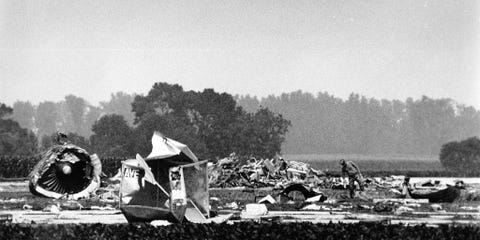
Brian Brainerd Getty Images
Yard CANYON | TWA Flight 2 and United Airlines Flight 718
Upgrade: Collision abstention and a meliorate ATC
In the skies higher up the Thou Canyon on June 30, 1956, two planes that had recently taken off from Los Angeles International Airdrome—a United Airlines Douglas DC-7 headed to Chicago and a Trans World Airlines Lockheed L-1049 Super Constellation on its manner to Kansas Metropolis—collided. All 128 passengers and crew aboard both flights were killed.
The accident spurred a $250 meg upgrade of the air traffic control (ATC) system—serious coin in those days. (Information technology worked: There hasn't been a collision betwixt two airliners in the United States in 47 years.) The crash as well triggered the cosmos in 1958 of the Federal Aviation Agency (at present Administration) to oversee air safe.
Nevertheless, farther improvements would exist implemented later on a small-scale private plane wandered into the Los Angeles final control area on August 31, 1986, striking an Aeromexico DC-nine and killing 86 people. The FAA afterward required small aircraft entering control areas to apply transponders—electronic devices that broadcast position and altitude to controllers.
Additionally, airliners were required to have TCAS II standoff-avoidance systems, which detect potential collisions with other transponder-equipped aircraft and advise pilots to climb or dive in response. Since then, no small plane has collided with an airliner in flying in the U.Due south.
PORTLAND | United Airlines Flying 173
Upgrade: Cockpit teamwork
On Dec 28, 1978, United Flight 173, a DC-viii approaching Portland, Ore., with 181 passengers, circled near the airport for an hour as the coiffure tried in vain to sort out a landing gear problem. Although gently warned of the rapidly diminishing fuel supply by the flying engineer on board, the helm—later described by one investigator as "an arrogant S.O.B."—waited as well long to begin his final approach. The DC-8 ran out of fuel and crashed in a suburb, killing 10.
In response, United revamped its cockpit training procedures effectually the then-new concept of Cockpit Resources Management (CRM). Abandoning the traditional "the captain is god" airline hierarchy, CRM emphasized teamwork and advice amid the crew, and has since become the industry standard.
"It's really paid off," says United helm Al Haynes, who in 1989 remarkably managed to bump a bedridden DC-10 at Sioux City, Iowa, by varying engine thrust. "Without [CRM training], information technology's a cinch we wouldn't accept fabricated it."
CINCINNATI | Air Canada Flight 797
Upgrade: Lav smoke sensors
The first signs of trouble on Air Canada 797, a DC-9 flying at 33,000 feet en route from Dallas to Toronto on June two, 1983, were the wisps of smoke wafting out of the rear lavatory. Presently, thick black smoke started to make full the cabin, and the plane began an emergency descent. Barely able to see the instrument console because of the smoke, the pilot landed the plane at Cincinnati. But soon after the doors and emergency exits were opened, the cabin erupted in a flash fire earlier anybody could go out. Of the 46 people aboard, 23 died.
The FAA subsequently mandated that aircraft lavatories exist equipped with fume detectors and automatic fire extinguishers. Inside 5 years, all jetliners were retrofitted with fire-blocking layers on seat cushions and flooring lighting to lead passengers to exits in dense smoke. Planes built afterwards 1988 take more flame-resistant interior materials.
DALLAS/FORT WORTH | Delta Air Lines Flight 191
Upgrade: Downdraft detection
As Delta Flight 191, a Lockheed L-1011, approached for landing at Dallas/Fort Worth airdrome on August 2, 1985, a thunderstorm lurked near the runway. Lightning flashed around the plane at 800 feet, and the jetliner encountered a microburst wind shear—a stiff downdraft and abrupt shift in the wind that acquired the aeroplane to lose 54 knots of airspeed in a few seconds.
Sinking rapidly, the L-1011 hit the ground about a mile brusk of the runway and bounced across a highway, burdensome a vehicle and killing the driver. The airplane then veered left and crashed into two huge airdrome h2o tanks. On board, 134 of 163 people were killed.
The crash triggered a 7-twelvemonth NASA/FAA research effort, which led straight to the on-lath forrad-looking radar wind-shear detectors that became standard equipment on airliners in the mid-1990s. Only one wind-shear-related accident has occurred since.
SIOUX Metropolis | United Airlines Flight 232
Upgrade: Engine safety improvements
United Airlines flight 232 was en route from Denver to Chicago on July 19, 1989 when the engine in the tail of the DC-x suffered engine failure, severing the plane'south hydraulic lines and rendering the plane almost uncontrollable. What followed for 296 people aboard was a horrific ordeal equally the captain, Alfred Haynes, struggled to land at a nearby airport. As information technology crash landed, the widebody craft cartwheeled off the track and caught fire, and it was considered something of a miracle that 185 passengers aboard survived.
The NTSB later adamant the accident was acquired past a failure by mechanics to notice a scissure in the fan disk that ultimately was traced back to the initial manufacture of the titanium blend material. The accident led the FAA to order modification of the DC-10's hydraulic system (the plane was already being phased out by many airlines) and to require redundant condom systems in all future aircraft, and it changed the manner engine inspections are performed.
MAUI | Aloha Airlines Flying 243
Upgrade: Retiring tin
As Aloha Flight 243, a weary, xix-year-one-time Boeing 737 on a brusk hop from Hilo, Hawaii, to Honolulu, leveled off at 24,000 ft. on April 28, 1988, a large section of its fuselage blew off, leaving dozens of passengers riding in the open up-air cakewalk. Miraculously, the residuum of the plane held together long enough for the pilots to land safely. Only one person, a flight attendant who was swept out of the plane, was killed.
The National Transportation Safety Board (NTSB) blamed a combination of corrosion and widespread fatigue damage, the result of repeated pressurization cycles during the plane's 89,000-plus flights. In response, the FAA began the National Aging Aircraft Research Program in 1991, which tightened inspection and maintenance requirements for high-apply and high-cycle shipping.
Post-Aloha, in that location has been only ane American fatigue-related jet blow: the Sioux City DC-ten.
PITTSBURGH | U.s.a. Air Flying 427
Upgrade: Rudder Rx
When US Air Flight 427 began its arroyo to state at Pittsburgh on September viii, 1994, the Boeing 737 suddenly rolled to the left and plunged 5000 anxiety to the ground, killing all 132 people on lath. The airplane's black box revealed the rudder had abruptly moved to the full-left position, triggering the roll. Just why?
USAir blamed the plane. Boeing blamed the crew. It took nigh five years for the NTSB to conclude a jammed valve in the rudder-control system had caused the rudder to contrary: As the pilots frantically pressed on the right rudder pedal, the rudder went left.
Every bit a result, Boeing spent $500 million to retrofit all 2,800 of the world's nearly popular jetliner. And, in response to conflicts between the airline and the victims' families, Congress passed the Aviation Disaster Family Assistance Human action, which transferred survivor services to the NTSB.
MIAMI | ValuJet Flight 592
Upgrade: Fire prevention in the concur
Although the FAA took anti-cabin-fire measures after the 1983 Air Canada accident, it did nothing to protect passenger jet cargo compartments—despite NTSB warnings after a 1988 cargo burn in which the plane managed to land safely. Information technology took the horrific crash of ValuJet 592 into the Everglades near Miami on May 11, 1996 to finally spur the agency to action.
The fire in the DC-9 was caused by chemical oxygen generators that had been illegally packaged by SabreTech, the airline's maintenance contractor. A crash-land apparently ready 1 off, and the resulting heat started a burn down, which was fed by the oxygen beingness given off. The pilots were unable to state the burning aeroplane in time, and 110 people died. The FAA responded past mandating smoke detectors and automatic fire extinguishers in the cargo holds of all commercial airliners. Information technology besides bolstered rules confronting conveying hazardous cargo on shipping.
LONG Island | TWA Flight 800
Upgrade: Electrical spark elimination
It was everybody'southward nightmare: a aeroplane that blew up in midair for no credible reason. The July 17, 1996, explosion of TWA Flight 800, a Boeing 747 that had merely taken off from JFK bound for Paris, killed all 230 people aboard and stirred great controversy.
Later on painstakingly reassembling the wreckage, the NTSB dismissed the possibility of a terrorist bomb or missile attack and concluded that fumes in the aeroplane'due south nearly empty center-fly fuel tank had ignited, most likely after a short circuit in a wire bundle led to a spark in the fuel gauge sensor.
The FAA has since mandated changes to reduce sparks from faulty wiring and other sources. Boeing, meanwhile, has developed a fuel-inerting system that injects nitrogen gas into fuel tanks to reduce the take a chance of explosions. It will install the organisation in all its newly built planes. Retrofit kits for in-service Boeings volition also be available.
NOVA SCOTIA | Swissair Flight 111
Upgrade: Insulation bandy-out
Virtually an hour afterward takeoff on September 2, 1998, the pilots of Swissair's Flight 111 from New York to Geneva—a McDonnell Douglas MD-11—smelled smoke in the cockpit. Four minutes afterwards, they began an firsthand descent toward Halifax, Nova Scotia, about 65 miles away. But with the fire spreading and cockpit lights and instruments failing, the plane crashed into the Atlantic nigh v miles off the Nova Scotia coast. All 229 people aboard were killed.
Investigators traced the fire to the plane's in-flight entertainment network, whose installation led to arcing in vulnerable Kapton wires above the cockpit. The resulting fire spread chop-chop along combustible Mylar fuselage insulation. The FAA ordered the Mylar insulation replaced with fire-resistant materials in most 700 McDonnell Douglas jets.
FROM RIO TO PARIS | Air France 447
Upgrade: Manual training to fix over-dependence on automation
Around three hours into its journeying from Rio to Paris on June 1, 2009, Air France Flight 447, an Airbus A330-200, headed into an surface area of severe thunderstorm action—it was never heard from again.
From an envelope-pushing altitude of 38,000 feet, the shipping entered an aerodynamic stall before plunging into the depths of the southern Atlantic Ocean, killing all 228 people aboard. Several days later, pieces of the wreckage were spotted floating on the h2o's surface, but the whereabouts of the residuum of the jet remained a mystery for more than ii years, when a privately funded search located the bulk of the fuselage, bodies of the victims, and the vital black box recorders.
Investigators had already solved role of the puzzle, relying on automated messages sent from the crippled plane as it went downward, revealing that the pitot tubes that track speed had frozen and malfunctioned, setting off a cascading series of events.
With the wreckage now institute, the evidence led experts to conclude the crash was acquired past the pilots' failure to take corrective action to recover from the stall.
The findings cast a harsh calorie-free on fly-past-wire technology and its reliance on computers, rather than humans, to make the final phone call on flight decisions. Boeing and Airbus both use wing by wire, but Boeing gives pilots the ability to override automation. The crash prompted a renewed effort to retrain pilots to manually wing the airplane–no matter what the computer is telling them.
Verbal LOCATION UNKNOWN | Malaysia Airlines 370
Upgrade (pending): Existent-time flying tracking
There was no May Day telephone call or sign of trouble when Malaysia Airlines Flight 370, a 777 conveying 239 people en route from Kuala Lumpur to Beijing, dropped off the radar screens on March 8, 2014. More than than 7 years later on, it's still aviation's nigh agonizing mystery.
The biggest question: why the plane's transponders were apparently disabled, making the jet almost invisible as it unaccountably changed course and headed south, where some experts believe it flew for upwards to seven hours on autopilot before running out of fuel and crashing into the Indian Sea.
In the absence of hard evidence—with few clues in the course of some barnacled flotsam establish off Africa–many competing theories of what happened have arisen, from hypoxia caused by rapid decompression (also the cause of the Helios Flight 522 crash in Greece), to intentional sabotage from a crew member or passenger.
One matter is clear: the world wouldn't still exist looking for the aeroplane if it had been equipped with real-time tracking, which rubber experts had been demanding ever since Air French republic 447. Equally a result of MH370, the International Civil Aviation Arrangement has ordered all airlines to install tracking equipment that will go on closer tabs on planes, especially those over the bounding main, and shipping manufacturers are also developing black boxes that would eject and float automatically when a airplane hits water.
Republic of indonesia and Ethiopia | King of beasts Air 610 and Ethiopian Airlines 302
Upgrade (Pending): Flight Command System on Boeing's 737 MAX 8 gets an update.
On October 29, 2018, King of beasts Air Flight 610, a Boeing 737 MAX viii, plummeted into the Java sea 13 minutes afterwards it took off from Soekarno–Hatta International Drome in Jakarta, Indonesia. In the weeks post-obit the crash, officials discovered the Pangkal Pinang-spring flying suffered flight control problems linked, in role, to a flaw in the new aircraft's Maneuvering Characteristics Augmentation Arrangement (MCAS). The arrangement, which mistakenly pushed the aeroplane's nose down despite the pilots' best efforts to correct it.
Five months afterwards, Ethiopian Airlines Flight 302—en route to Nairobi, Kenya, from Addis Ababa, Ethiopia—crashed only 6 minutes subsequently take-off. Investigations revealed the Boeing 737 MAX viii suffered a similar fate every bit Flight 610. Between the two accidents, 346 people perished.
In the wake of the two incidents, the FAA and Boeing grounded all 737 MAX viii jets to fully investigate the aircraft, right wiring bug and repair the flight command arrangement and allow pilots to receive more training on the aircraft.
In Nov 2020, the MAX was accounted safety enough to fly. Only its troubles are far from over. In April 2021, Boeing issued a statement ordering the grounding of around 160 MAX 8 jets to accost yet some other software issue.
Barbara Peterson Writer Barbara Peterson is a announcer living in New York, who writes often about aviation.
This content is created and maintained past a tertiary party, and imported onto this page to help users provide their email addresses. You may be able to find more information about this and similar content at pianoforte.io
A Pitot Tube on an Airplane Flying at Standard Sea Level Reads
Source: https://www.popularmechanics.com/flight/g73/12-airplane-crashes-that-changed-aviation/
0 Response to "A Pitot Tube on an Airplane Flying at Standard Sea Level Reads"
Post a Comment